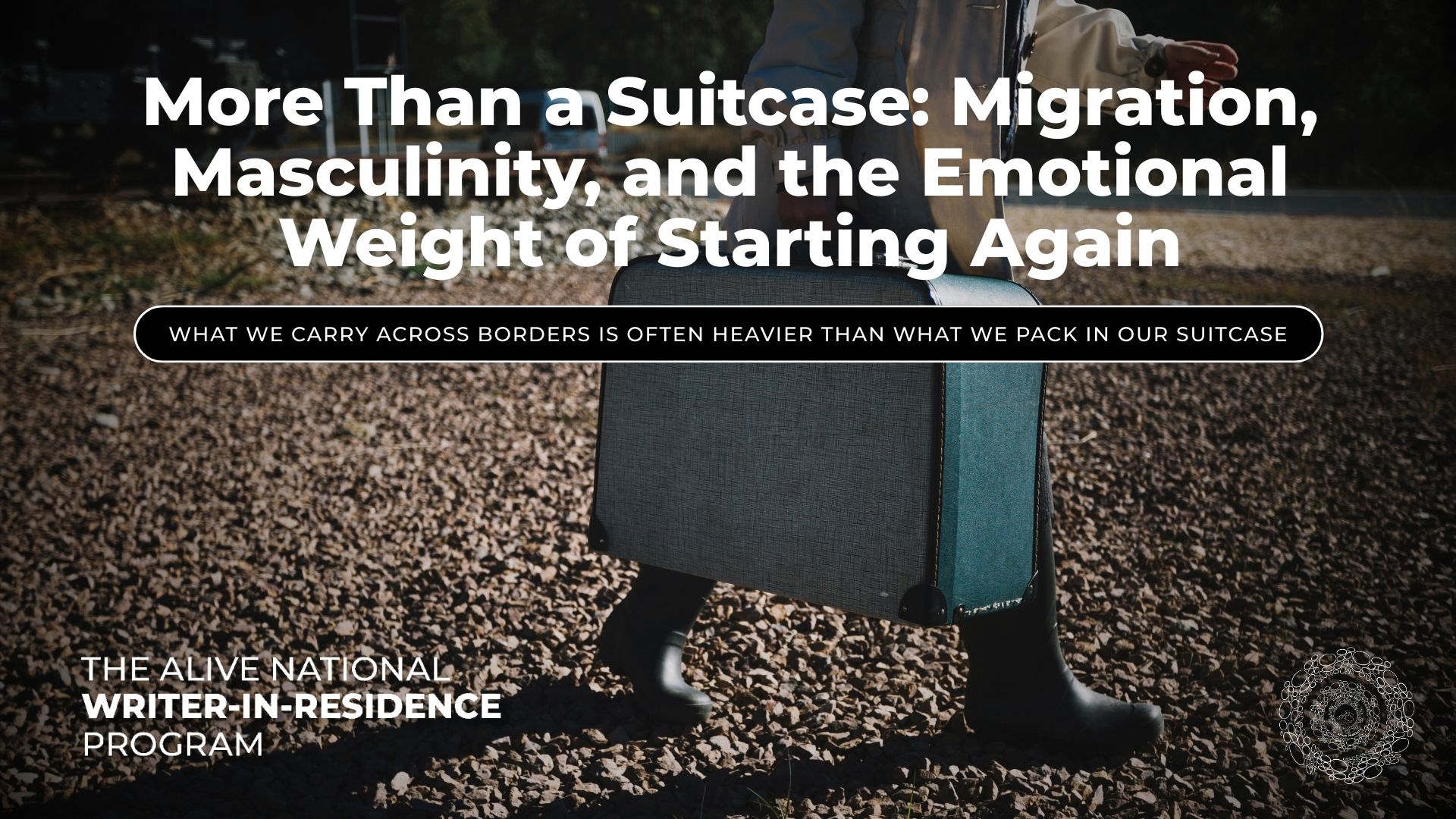
What we carry across borders is often heavier than what we pack in our suitcase

Interested in our initiative? Submit your email to receive an invite to the alive collective.
Written by Michael Elwan – Lived Experience Solutions (LEXs)
This new series is written from lived experience. It includes personal reflections on illness, loss, and caregiving. Please read Michael Elwan’s writer-in-residence series with awareness and care.
Alexandria to Australia
The automatic doors slid open and a rush of cool airport air hit my face. It was still dark outside. I was in my twenties, alone, pushing a trolley stacked with suitcases that wobbled on every bump in the floor. Around me, families reunited in bursts of noise; friends leaned into long hugs; announcements rolled overhead in accents I needed to strain to understand. No one was waiting for me. No familiar voice calling my name. Just a terminal at Sydney Airport and the faint sting of beginning again in a place where nothing resembled home.
The differences arrived fast. Signs explaining rules I didn’t know yet. Queues forming in patterns unfamiliar to me. People speaking quickly and without the casual warmth I had grown up with in Alexandria, where even strangers carried some version of neighbourliness. Here, independence was the default. My belongings crossed the border easily. The weight of grief and responsibility I carried took far longer to unpack.
People imagine migration as a clean slate. In reality, it begins with what you couldn’t release: the moments that shaped you, the duties that aged you early, the versions of yourself formed long before you had a choice in them. When people later asked why I moved, I gave the answers that fit neatly into conversation; opportunity, safety, a chance to rebuild. They were true, but they were not the full story.
Stepping away from Egypt also meant stepping away from the walls I built around my mother’s suffering and the routines that shaped my father’s final years. It meant leaving behind a version of masculinity grounded in endurance and quiet survival. That instinct to stay silent travelled with me more reliably than any suitcase.
As I pushed the trolley toward the taxi rank, the glass doors reflecting my tired face, it felt as if every age of my life stood beside me: the boy guiding a blind father, the teenager whispering reassurance through a closed bedroom door, the young man who learned to hide difficulty behind competence. Migration compresses time like that. It brings your past into your present and asks you to keep walking until you find somewhere safe enough to set something down.
The double migration of the heart
My first winter in Australia settled over me before I understood it. I was renting a small room in Canberra, the kind with thin walls and a heater that buzzed more than it warmed. At night, the stillness outside felt heavier than the cold. In Alexandria, even silence had texture – neighbours’ voices drifting through open windows, the hum of a motorbike, someone calling out across a balcony. Here, the quiet felt absolute.
I lay awake listening to it, trying to translate myself into this new world. Each day required learning something unfamiliar – how to navigate government forms, how to understand bus timetables, how to speak in ways that made people comfortable rather than cautious. I had crossed a physical border, but the habits that anchored me in Egypt crossed with me: the instinct to keep things private, the reluctance to burden others, the belief that hardship belonged behind closed doors.
This is the second migration; the inner one. You leave a country, yet its meanings stay lodged in your body. You begin a new life, yet you interpret everything through the emotional grammar of the old one. Back home, distress was explained through faith, responsibility, or fate. Here, people named their feelings with a fluency that felt foreign to me. I wasn’t sure how to live between these two emotional dialects.
That first winter taught me what I couldn’t yet articulate: It takes a day to unpack a suitcase, but far longer to unpack yourself.
What migrant men carry
In the years since that first winter, I’ve sat with migrant and refugee men whose stories echo my own in unexpected ways. They speak slowly at first, careful with their words. Many hold grief for the parents they left behind or the childhoods interrupted by crisis. Others carry the pressure to succeed quickly in a country where survival often depends on confidence, not caution. Some feel responsible for whole families across oceans. Others mourn versions of themselves they never had time to become.
These conversations always begin with small sentences:
It’s been a long few years.
I’m tired, but I’ll manage.
I don’t want to worry anyone.
What looks like avoidance is often love.
What looks like resilience is often exhaustion.
What looks like strength is often a man trying very hard not to break in front of you.
I recognise the postures; shoulders lifted slightly, voice steady, eyes alert to judgement. I used to hold myself the same way. Silence was my shield long before it became my burden.
For many men, especially those navigating new countries, identity becomes a negotiation between responsibility, culture, and survival. They are expected to be both unshakeable and adaptable, strong but never overwhelmed, grateful but never struggling. It takes time (and safety) before the truth begins to rise.
When systems don’t speak your language
Australia’s mental health system was far more resourced than anything I had known in Egypt, yet it still felt complicated to enter. Services spoke English with confidence; suffering often speaks in childhood languages. Systems valued verbal openness, while the world I came from valued quiet perseverance. Services looked for individual recovery, while I expected collective responsibility.
Many men I’ve worked with describe feeling assessed before they feel understood. Conversations focus on symptoms before stories, risk before connection. They walk into services carrying decades of cultural messages about shame, duty, faith, and family, only to find those dimensions rarely recognised.
In Egypt, help was limited by stigma.
In Australia, help is sometimes limited by structure.
Different barriers; similar loneliness.
A person can sit in front of a service, tick all the boxes, and still feel invisible. Connection (not paperwork, not policies) is what allows someone to speak before they reach breaking point.
Rewriting masculinity while rebuilding a life
Starting again in Australia, for me,meant re-learning what strength could look like. Working night shifts, finding my footing in a new culture, and slowly unlearning the instinct to carry everything alone taught me that resilience can be quieter, softer, and more relational than anything I had seen growing up.
I learned that asking for support doesn’t erase dignity.
That grief is not a personal failing.
That rest is not the opposite of responsibility.
These lessons now shape the way I work with men from multicultural communities. When someone tells me they are “fine” I listen to the tone beneath the word. When someone hesitates to speak, I pay attention to what the silence is protecting. Many men are not avoiding care; they are guarding the parts of themselves they’ve never been given permission to show.
Where systems can meet migrant men better
Across countries, cultures, and years of listening to men rebuild their lives, certain patterns have stayed with me. They point toward ways practitioners and services can work with migrant men more accurately and with greater respect for their realities. These principles come from lived experience, clinical practice, and long conversations with men carrying heavy stories:
Ask what distress signifies in the person’s world: spiritually, culturally, relationally. Stories land differently when they’re understood in their native context.
Many migrant men carry responsibility and heartbreak at the same time. Recognising this dual load opens a door that clinical questions alone cannot.
Words like “pressure”, “strain”, or “carrying too much” often resonate more than clinical labels. They invite honesty rather than performance.
People rebuild their inner world at the same time they rebuild their outer life. Services need to acknowledge both.
Men speak more freely when they feel respected, not inspected. Safety grows through presence, consistency, and cultural humility.
Many cultures understand healing as a collective project. Involving families in the right way strengthens trust and reduces isolation.
These are not specialist skills; they are relational ones. And they matter more than we often admit.
When I think back to that morning in Sydney Airport, I understand now that the suitcases were the least significant part of what I carried. The heavier weight was invisible; the grief held quietly, the responsibility learned too young, the hope I couldn’t yet name.
Today, when I sit with migrant men who speak in guarded sentences or long pauses, I recognise something familiar. They’re not withholding; they’re carrying. And our work (in practice, in policy, and in community) is to help them place that weight down gently, without losing their dignity.
Migration asks people to begin again.
Good care ensures they don’t have to begin alone.
About the writer